








Events
Peter Bergan to Moderate Panel at TMT Finance USA 2026
Partner Peter Bergan will moderate a panel at TMT Finance USA 2026 on October 6 titled “How is Datacenter Powered …
October 6, 2026
October 6, 2026 • 1-minute read


Insight
Client Alerts
V&E Antitrust Update
September 1, 2023 • 3-minute read
An important federal appeals court has clarified a key principle of antitrust law in a way that potentially makes it more difficult for an employer to win a motion to dismiss, and thereby avoid expensive discovery, with respect to company agreements that contain commonly used hiring restrictions. The appeals court ruled that trial courts must not decide at the pleading stage whether the “ancillary restraints doctrine” prevents per se (automatic illegality) treatment of so-called no-poach agreements, thereby depriving employers of a defense that they often have used to dismiss claims or convert them into antitrust “rule of reason” claims, which are far harder for plaintiffs to win.
In cases under Section 1 of the Sherman Act, the legality of an agreement that contains a “restraint” on competition (restriction of parties’ or third parties’ ability to compete) hinges on whether the agreement is assessed under the per se rule, which means automatic illegality, or the Rule of Reason, which requires a court to weigh the alleged anticompetitive effects of the agreement against its procompetitive benefits and business justifications. Under the “ancillary restraints doctrine,” an agreement that is subordinate and collateral to a separate, clearly procompetitive transaction, and reasonably necessary to achieve the goals of that other transaction is assessed under the Rule of Reason, even if the subordinate agreement would typically be assessed under the per se rule if it were standing alone. Employers often justify hiring restrictions in agreements as ancillary restraints, reasoning that, for example, no-poach or non-solicit provisions are necessary for two companies to feel comfortable introducing each other’s key employees to the other’s during the course of a business collaboration.
On August 25, 2023, the U.S. Court of Appeals for the Seventh Circuit, in an opinion authored by Judge Frank Easterbrook, revived McDonald’s workers’ antitrust suit against the McDonald’s corporation, providing useful clarification on pleading standards for the ancillary restraints doctrine in Section 1 complaints and the extent to which courts should decide fact intensive questions at the motion to dismiss stage. Importantly, the Seventh Circuit’s ruling provides a signpost to lower courts that the classification of “ancillary restraints” should not be hastily reached on the pleadings. And it reinforces that no-poach agreements continue to receive heavy scrutiny in courts and by regulators. Judge Easterbrook emphasized that “[a] restraint does not qualify as ‘ancillary’ merely because it accompanies some other agreement that is itself lawful.” In implementing any provisions that limit output or affect employee wages or mobility, it is essential for businesses to heed the associated risks and narrowly tailor the provisions to achieve the goals of any legitimate business objective that may be at issue.
The suit centers on 2017 allegations by plaintiffs, who formerly worked as managers at Florida and Kentucky McDonald’s locations. According to the plaintiffs, McDonald’s enforced a policy in which franchisees were prohibited from poaching workers from one another or from corporate-owned stores, which caused them to lose out on higher paying jobs and professional growth opportunities. The plaintiffs initially sought class certification but were unsuccessful in their efforts, and so they continued forward only on their own behalf. After multiple years of discovery, in June 2022, District Judge Jorge L. Alonso granted McDonald’s judgment on the pleadings after finding that the no-poach provisions were subject to the Rule of Reason as ancillary restraints that resulted in pro-competitive benefits, and that the plaintiffs had failed to allege McDonald’s market power in the relevant markets.
The plaintiffs appealed the district court’s judgment and, ultimately, succeeded in convincing the Seventh Circuit that the district court had erred. In vacating the district court’s opinion and remanding for further proceedings, the Seventh Circuit held that the district court incorrectly concluded that the no-poach agreements were “ancillary” restraints and had judged the merits of the plaintiffs’ claims too early. According to Judge Easterbrook, the district court “jettisoned the per se rule too early” by prematurely deciding that the no-poach provisions were ancillary simply “because [they] appeared in franchise agreements.” Instead, the district court should have answered important questions about the scope, length, restrictiveness, and objectives of the no-poach provisions. Judge Easterbrook emphasized that “[t]hese are all potentially complex questions, which cannot be answered by looking at the language of the complaint,” and “require careful economic analysis.” Accordingly, the Seventh Circuit remanded the case to the district court to answer those questions and determine whether the no-poach provisions were, in fact, ancillary or, instead, should be assessed under the per se rule.
For more discussion by the V&E team on no-poach issues, please see:
This information is provided by Vinson & Elkins LLP for educational and informational purposes only and is not intended, nor should it be construed, as legal advice.
Discover our latest:
Events
Peter Bergan to Moderate Panel at TMT Finance USA 2026
Partner Peter Bergan will moderate a panel at TMT Finance USA 2026 on October 6 titled “How is Datacenter Powered …
October 6, 2026
October 6, 2026 • 1-minute read
CLE Events
Texas Reincorporation 101: Recent Developments and Key Considerations for Boards
Join Vinson & Elkins and FTI Consulting for a webinar on the growing trend of companies reincorporating to Texas.
October 1, 2026
October 1, 2026 • 1-minute read

CLE Events
Financing and Bankability of Data Center Projects
This program will examine the key legal and commercial considerations for financing data center projects, with a focus on what makes these projects bankable for lenders and investors.
September 29, 2026
September 29, 2026 • 1-minute read

Events
Paige Anderson to Speak on BARBRI Webinar
Partner Paige Anderson will speak on BARBRI’s live video CLE program, “Mastering Public and Private REITs: Key Tax, Structuring, Financing, …
September 22, 2026
September 22, 2026 • 1-minute read

Events
Partners Paige Anderson and Vinay Prabhakar will present on myLawCLE’s live CLE program, “REIT Tax in the Data Center Era: …
September 18, 2026
September 18, 2026 • 1-minute read

Deals & Cases
Vinson & Elkins Advises Group 1 Automotive on $1.25 Billion Senior Notes Offering
Vinson & Elkins advised Group 1 Automotive, Inc., a Fortune 250 automotive retailer, in connection with its private placement of …
September 23, 2026
September 23, 2026 • 1-minute read

Deals & Cases
Vinson & Elkins Advises SCF Partners on Close of $800 Million Fund XI at Hard Cap
Vinson & Elkins advised SCF Partners, an investment manager headquartered in Houston, Texas, on the successful formation and final close …
September 23, 2026
September 23, 2026 • 1-minute read

Firm News
Finegold and Comber bring market-leading structured finance experience across energy and infrastructure, including digital infrastructure, and other esoteric asset classes. …
September 21, 2026
September 21, 2026 • 3-minute read

Deals & Cases
Vinson & Elkins advised Goldman Sachs, its West Street Climate Credit Fund (part of Goldman Sachs Asset Management’s private credit …
September 21, 2026
September 21, 2026 • 2-minute read

Deals & Cases
Vinson & Elkins Advises Ellington Financial on $150 Million Senior Notes Offering
Vinson & Elkins served as counsel to Ellington Financial Inc. (NYSE: EFC) (the “Company”) in connection with its offering of …
September 17, 2026
September 17, 2026 • 1-minute read

Articles
Law Is a Practice. So Is Business Development.
Randi Revisore, Lauren Alford, and DeAnna Englezos reflect on two years of success leading BD Lab — Vinson & Elkins’ …
July 14, 2026 • V&E+ | Values
July 14, 2026 • 7-minute read

Articles
Data Center Dealmakers: A New Era of Power and Compute
Vinson & Elkins Partners Creighton Smith and Milam Newby share the story behind a groundbreaking AI infrastructure transaction — and …
June 15, 2026 • V&E+ Ventures
June 15, 2026 • 5-minute read

Client Alerts
Mid-Level Mindset: Empowering Lawyers Through a Pivotal Career Stage
Vinson & Elkins’ inaugural Mid-Level Associate Summit brought lawyers from across the firm to Houston for three days of learning …
March 31, 2026
March 31, 2026 • 5-minute read

Client Alerts
Pro Bono at Vinson & Elkins: Lawyers Changing Lives
Pro Bono Counsel Parker Cragg reflects on a life dedicated to service, returning to Vinson & Elkins, and wisdom he has picked up along the way.
October 20, 2025 • V&E+ Values
October 20, 2025 • 6-minute read

Client Alerts
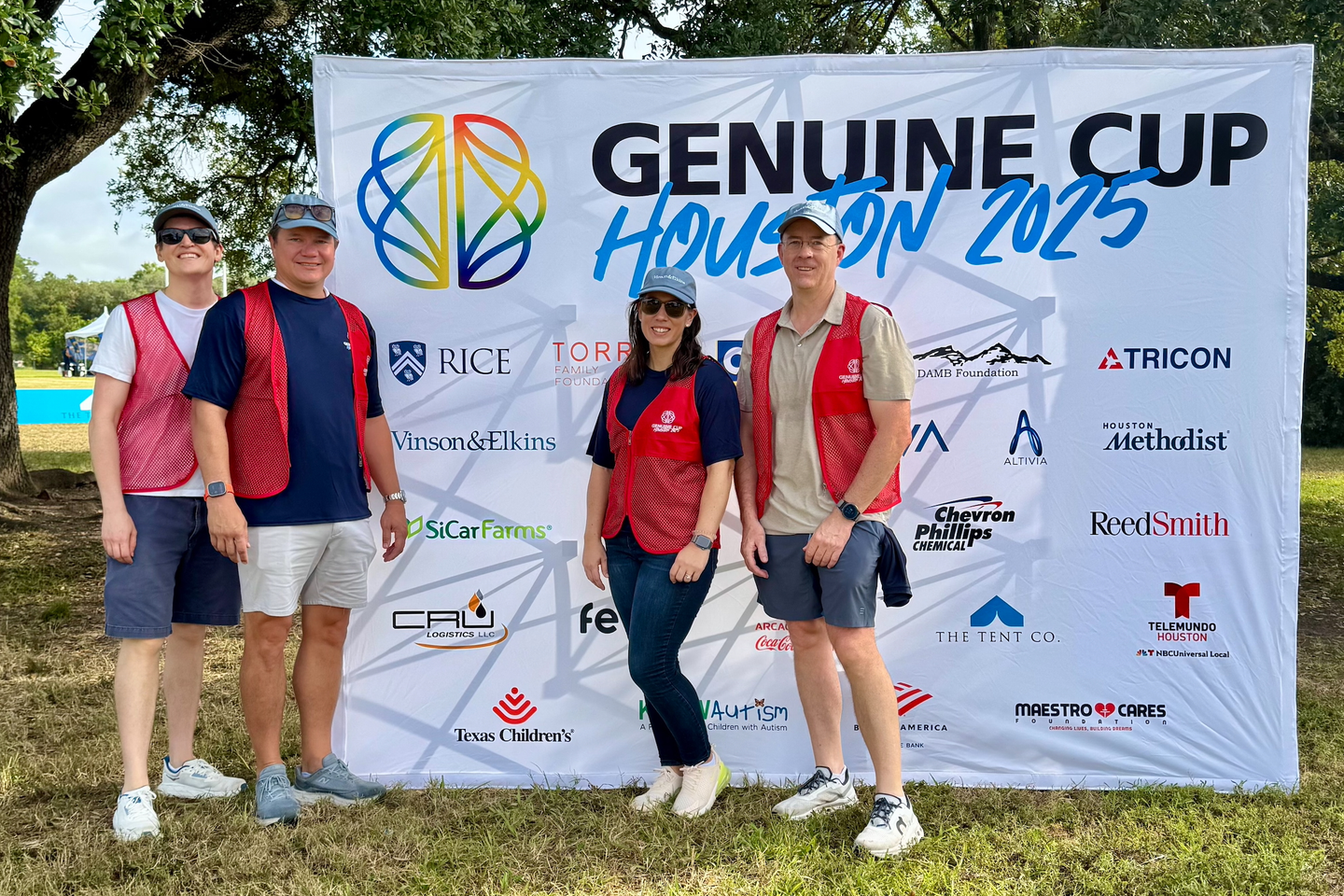
The Genuine Cup: Soccer Strengthens Our Communities
Vinson & Elkins Chair Keith Fullenweider and Vice Chair Hilary Preston, alongside partners Creighton Smith and Jenny Speck, sit down for conversation on a global soccer tournament, the firm’s support for it, and their experience as spectators and volunteers.
August 27, 2025 • V&E+ Values
August 27, 2025 • 7-minute read

Thoughts or questions? Send us a note, and we’ll connect you with the right person.
